The Hidden Cost of Manual Attendance Tracking
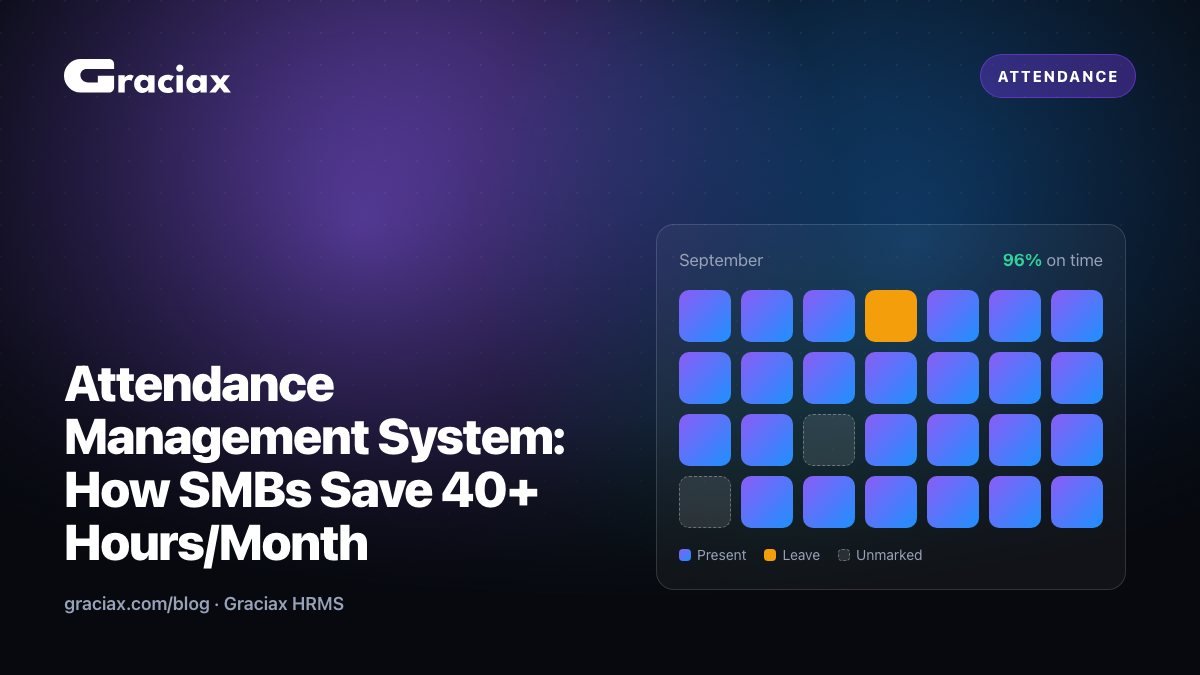
Picture this: it is the 1st of the month. Your HR executive is hunched over a paper register, squinting at pencil marks, cross-checking them against a WhatsApp group export, and mentally calculating late marks. By the time she finishes, the payroll cycle has already eaten 6 working hours, and she still has to do LOP calculations, overtime adjustments, and leave reconciliation. Multiply that by 12 months. That is more than 72 hours per year lost to a process a phone can do in seconds.
Manual attendance is not just slow. It is a silent ROI killer: buddy punching alone costs SMBs an average of 2% to 5% of their monthly wage bill. On a ₹20 lakh monthly payroll, that is ₹40,000 to ₹1 lakh walking out the door, every single month. A modern attendance management system recovers that money in week one.
What is an Attendance Management System?
An Attendance Management System (AMS) is software that automates how employees mark in, mark out, and get counted as present, late, absent, or on leave. It replaces paper registers, Excel sheets, and ad-hoc WhatsApp pings with a single source of truth that feeds directly into payroll.
A good AMS is not just a clock. It should handle:
- Multiple check-in modes, mobile, web, biometric, kiosk.
- Shift patterns, day, night, rotational, flexi.
- Overtime and LOP rules, automated calculations per policy.
- Leave & holiday integration, auto-sync with leave calendars.
- Real-time dashboards, managers see who is working, who is late, who is on leave.
5 Types of Attendance Tracking Methods Compared
Not every method suits every business. Here is a no-nonsense comparison of the five most popular attendance methods used by SMBs.
- 1. Biometric (Fingerprint / Face): Highly accurate, impossible to buddy-punch, but hardware-heavy, location-bound, and painful for field workers. Best for: factories, single-office teams.
- 2. RFID / Access Cards: Fast and reliable but cards get shared or lost. Best for: larger offices with turnstile infrastructure.
- 3. Mobile App Check-in: Employees punch in via smartphone, with selfie verification. Flexible, scalable, zero hardware cost. Best for: hybrid, remote, and distributed teams.
- 4. Geo-fencing / Geo-attendance: Mobile-based, but restricted to specific GPS zones. Perfect accountability for field staff. Best for: sales reps, delivery teams, field engineers.
- 5. Web-based Kiosk: A tablet at the entrance where employees tap and punch in. Low-cost alternative to biometric. Best for: small offices with shared devices.
Why Geo-Attendance is the Future
In 2026, over 35% of India's workforce is either field-based, remote, or hybrid. Biometric machines simply cannot cover them. Geo-attendance, a mobile-first method that ties check-in to a GPS location, has become the default for modern SMBs, and for three very practical reasons.
- Accuracy: Employees can only check in when they are physically inside a pre-defined zone (office, client site, warehouse).
- Zero hardware cost: Every employee already has a smartphone. No ₹15,000 biometric machine per location.
- Works anywhere: Multi-branch, multi-city, or field-deployed teams all use the same system without infrastructure upgrades.
Adoption of mobile / geo-attendance among SMBs (2022 to 2026):
78% of SMBs using HR software in 2026 rely on mobile or geo-attendance as the primary method.How Geo-Attendance Works
The magic happens in four simple steps, visible to the employee but invisible to the HR team that used to manage it all manually:
- HR defines geo-zones, a radius around each office, client site, or branch is drawn on a map.
- Employee opens the mobile app, the app reads current GPS coordinates and checks them against allowed zones.
- Selfie + timestamp + location captured, stored in tamper-proof logs on the HRMS server.
- Payroll auto-updated, present days, late marks, and working hours sync directly to the payroll module.
Real-World Use Cases
Here is how different SMBs use geo-attendance to solve real operational headaches.
- Sales Reps: A travel company's BDMs check in from client offices, and managers see coverage maps by city. No more fake visits.
- Delivery Teams: A logistics firm with 80 riders uses geo-attendance tied to depot zones, riders cannot start earning till they are physically at the depot.
- Field Engineers: A solar installation company tracks attendance at customer sites, auto-computes site-allowance, and creates audit trails for client billing.
- Retail Staff: A retail chain with 12 stores uses the same app across all outlets, and HQ sees live presence data on a single dashboard.
Integrating Attendance with Payroll
Attendance data is worthless if it does not flow into payroll automatically. A good HRMS connects the dots between check-ins, leave balances, shift policies, and compensation rules.
- Overtime: Any hours beyond standard shift length are flagged, approved, and auto-paid as per policy.
- Loss of Pay (LOP): Unapproved absences deduct from monthly gross based on actual attendance data.
- Late marks and penalties: Configurable rules (three lates = half day, for example) run automatically.
- Short leave & half days: Handled cleanly with start/end time markers.
- Leave integration: Approved leaves from the leave management module auto-mark attendance correctly.
GPS, selfie or biometric. One attendance ledger.
Graciax HRMS supports GPS and selfie check-in from the mobile app and integrates with ZKTeco, eSSL, BioMax, Realtime, Suprema, HikVision and Matrix devices. Every punch flows straight into leave and payroll.
Implementation Checklist
Rolling Out an Attendance Management System in 7 Days
- Define your attendance policies, shift timings, grace period, LOP rules, overtime.
- List all work locations and set geo-zone radius (typically 50 to 200 metres).
- Import employee master data, name, department, shift assignment.
- Install the mobile app on a test device and run a pilot with 5 employees.
- Communicate the change clearly, benefits, privacy, what happens to the old register.
- Train managers on the approval dashboard.
- Go live in the next payroll cycle, no parallel runs, keep it decisive.
- Review first-month data and adjust policies if needed.
Frequently Asked Questions
1 What is the best attendance management system for small business in India?
2 Is geo-attendance legal in India?
3 Can I use attendance software without internet?
4 How does an attendance system reduce payroll errors?
5 How long does it take to implement an attendance system?
Stop Counting Heads, Start Growing Revenue
Every hour your HR spends chasing attendance is an hour not spent on hiring, culture, or employee experience. A modern attendance system moves that cost from your people to your software, and turns raw punch-in data into insights that help you staff smarter, reduce LOP, and plug wage leakage.
Ready to see it in action? Explore Graciax's attendance tracking module or start your free trial, and reclaim those 40+ hours every month.