
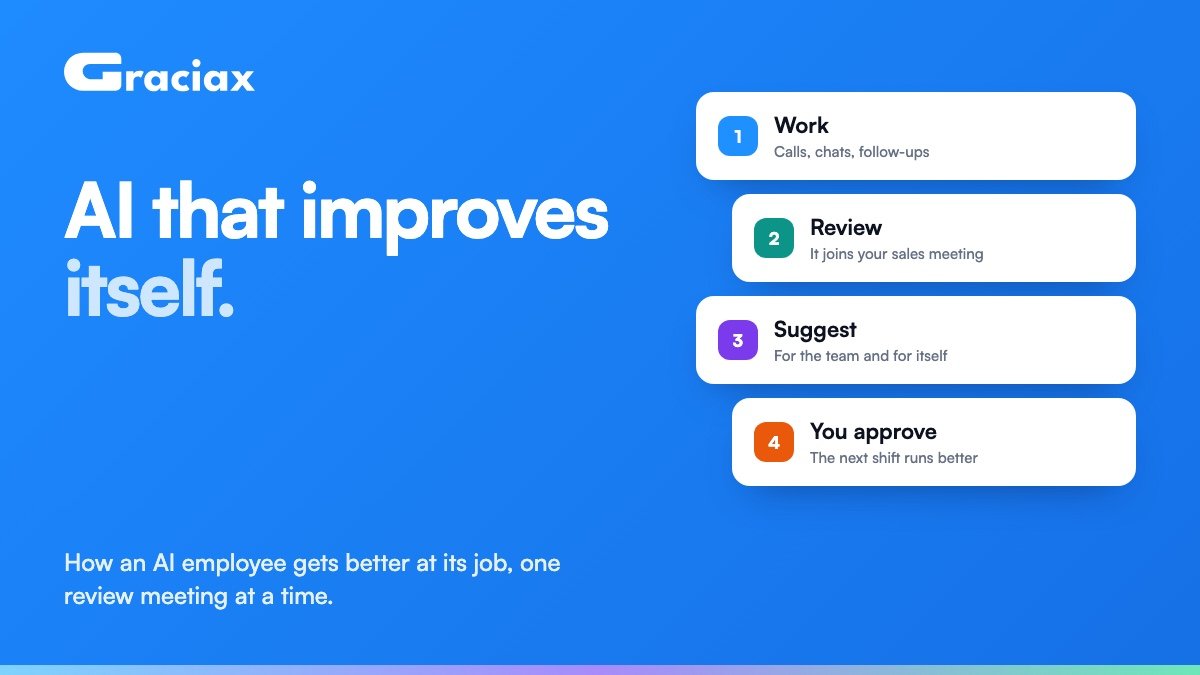
A new hire gets better. Should an AI one?
Hire a telecaller and the first week is rough. They read the script word for word, quote the price too early and lose people in the first fifteen seconds. By week six they are good. Nobody retrained them. They remembered what worked, their manager told them what did not, and they changed.
An AI employee should follow the same curve. Most do not. They make the same mistake on call five hundred that they made on call one, because nothing connects what happened yesterday to what they do today. That connection is what “AI that improves itself” should mean.
Three things “improves itself” can mean
1. The model is retrained
The vendor trains a new model. This is slow, it happens on their side, and it is not something your business controls. If a vendor says their AI learns from your customers’ calls this way, ask exactly what data leaves your account.
2. The agent remembers
Before it calls a lead again, it reads what was said last time. It knows your brand facts, the claims it is allowed to make and the preferences you stated once. This is memory, and it is the cheapest improvement there is.
3. The agent gets better instructions from its own results
Someone, or something, reads the results and changes the script. This is where most of the gain is, and where a meeting comes in.
The loop: work, record, review, change
| Step | What happens | Who does it |
|---|---|---|
| Work | Calls made, chats answered, follow-ups sent | AI employees |
| Record | Transcript, summary, objection and outcome on every lead | Automatic |
| Review | The numbers and the patterns, brought to your meeting | The reporting analyst |
| Suggest | Changes for the team and for the agent’s own script | The AI, in the meeting |
| Approve | Yes, no, or edit | You |
| Change | The next shift runs with the new script | AI employees |
What happens in the meeting
This is the part most tools skip. In Graciax an AI employee joins your weekly sales review on Google Meet, Teams or Zoom. It does three things.
It reports first. Leads worked, meetings booked, leads nobody touched, where calls ended and which objection came up most. Nobody spends Sunday night building the deck.
It listens. When your best salesperson explains how she handles “I will think about it”, that answer is now in the room. When the owner says the weekend offer has ended, that is too.
It leaves with suggestions. Some are for people: these eleven leads need a call today, this proposal has gone stale, this objection needs a better answer from the team. Some are for itself: stop quoting the price before the customer asks, add the new offer, use the answer that worked. Each one is a line you can approve, edit or reject.
Why a person approves
An agent left to tune itself will improve the number it can see. Tell it to book more demos and it will book more demos, including ones nobody attends.
We saw this in our own agents. A review of real calls found one asking for a demo five turns in a row, and another reciting the price before anyone had asked. No dashboard flagged either, because the booking numbers looked fine. People reading transcripts found them, and people decided the fix.
So the rule is simple. The AI suggests. A person decides. Every change is logged and can be undone.
Five questions for any vendor who says “self-improving”
1. What does it remember, and where can I see it?
Memory you cannot read is memory you cannot correct.
2. Does it train on my customer data?
Get a plain yes or no, and ask what is removed before anything reaches a model.
3. Who approves a change to what it says?
If the answer is “nobody, it learns”, you are the test audience.
4. Can I undo a change?
You will want to, at least once.
5. Which number tells me it got better?
Meetings held, not meetings booked. Replies, not messages sent.
What to measure
| Measure | Why it matters |
|---|---|
| Minutes to first contact | The one number an AI employee should fix on day one |
| Share of calls that pass 30 seconds | Shows whether the opening works |
| Meetings held, not booked | The honest version of the booking number |
| Leads untouched after 24 hours | Should fall every week |
| Hand-overs to a person | Too many means the script has gaps. Too few means it is not letting go. |
Frequently asked questions
Can AI really improve itself?
In a useful, limited sense, yes. An AI employee can remember what happened, read its own results, sit in your review meeting and suggest changes to how it works. In Graciax a person approves each change before the next shift runs with it.
Does a self-improving AI agent retrain on my customer data?
That depends on the vendor, so ask. The improvement described here does not need retraining. It comes from memory and better instructions. In Graciax, names and phone numbers are replaced with tokens before a prompt is built.
What does the AI do in a meeting?
It joins your Google Meet, Teams or Zoom call on request, reports the numbers, listens, and leaves with the minutes, the tasks and a short list of suggestions for the team and for its own script.
How fast does an AI employee get better?
As fast as you review it. A weekly review meeting gives you a weekly improvement cycle. The first few weeks usually change the most, because the script has never met real customers before.
Is it safe to let AI change its own script?
Not unsupervised. An agent that tunes itself will chase whichever number is easiest to move. Keep a person on the approval, keep every change logged, and make sure you can undo it.
Where Graciax sits
Graciax AI employees remember the last conversations with a lead, keep one living note per chat, and work from a memory of your brand, claims and preferences. Every call is transcribed and summarised. A watcher and a reporting analyst read across the work, and an agent can join your review meeting on request. Anything that changes what an agent says or sends waits for your approval, and Undo reverses it. The agents do not rewrite their own scripts unsupervised, and that is on purpose.